
Anatomy of the Soul #2 - Prayer and Our Troubles

A Prayer Guide

1. Read psalm 77 Aloud

2. A Guide to Understanding Psalm 77

When Trouble Comes: Psalm 77 is a prayer for our times of trouble and stress in life. Verse 2 tells us the occasion for this prayer – “I cry aloud to God, aloud to God, and he will hear me. In the day of trouble, I seek the Lord”. “Trouble” here can refer both to the outward cause of our trouble (challenging circumstances) and/or the inward experience of trouble (stress). This Psalm and many others show us that the day of trouble is also to be the day of prayer.  Many people struggle to speak their troubles aloud - instead choosing to keep it all inside. Psalm 77 teaches us our stress is not to be held inside and resisted; nor is it to relieved by distractions and pleasures – it is to be expressed to God aloud in prayers of lament. 

Lament goes beyond praying, “God! I’m in trouble! Get me out of this!” Lament is praying our troubles (or the troubles of others) to God. To lament is to describe the trouble we are facing and the feelings we have about our troubles to God. This is what the Psalmist does in verses 2-9. He speaks to God about his troubled soul, his struggle to pray and the questions that arise in his mind. Psalm 77 assures us God wants us to pray like this and he always hears the lament of those who seek Him in the day of trouble. 

When Prayer Brings More Trouble: There are many reasons we struggle with lament. One of the reasons is what happened here in this Psalm. When the Psalmist lamented aloud to God (just like he was taught to), what happened? He became more troubled. Prayer made things worse! He found no comfort (v2). He could only groan in weakness (v3). His troubles kept him awake at night and memories of better times brought more pain (v4-6).  When this happens, we think, “Prayer isn’t working! God isn’t listening!” But there’s an assumption we are making in our distress. It goes like this - if God doesn’t fix my circumstances or my troubled emotional state, He must not hear me. If God was listening, He would end my trouble! He’d end my stress!

Psalm 77 challenges this assumption. It shows us that before God deals with our troubles, He often wants to deal first with us. He doesn’t just want to bring us out of trouble; He wants to teach us in our trouble. This was true for Jesus: In the days of his flesh, Jesus offered up prayers and supplications, with loud cries and tears, to him who was able to save him from death, and he was heard because of his reverence. Although he was a son, he learned obedience through what he suffered (Hebrews 5:7,8). There are some things we can only learn through lament. We learn God doesn’t exist to obey us; we exist to obey Him. We learn reverence for God and his will. He can be trusted even in our troubles.

How Prayer Brings Us Through Trouble – For a time, prayer brought more grief and trouble, but the Psalmist didn’t stay there. There is a dramatic shift in this prayer that begins in verse 10. The prayer moves from a meditation inward to a meditation outward. In verses 2-9, the first person (inward) meditation dominates (my trouble, my hand, my soul, my eyelids, my song I used to sing, my heart, my spirit, etc). This is the hard but important work of lamentation. But it’s not enough. We need to get outside of ourselves and our troubling circumstances and emotions. This happens when we make the shift to outward meditation on who God and what he has done.

In verses 11-12, the Psalmist says, I will remember the Lord’s works, yes I will remember your wonders of old, I will ponder all your work and meditate on your mighty works.” He turns his mental, emotional and spiritual energy to God and his redemptive actions in history. This takes him to the greatest act of redemption in the OT – the exodus. He “prays himself there” – seeing God’s power deliver his people. In meditation on God’ act of redemption, these things became real to him:

  • God is more powerful than my troubles and feelings. (He is above the storm v16-17)

  • God makes a path through my troubles. (Your way went through the sea v19)

  • God is present with me in my troubles, even when we can’t see him (your footprints were unseen v19)

The Exodus was the greatest act of redemption the Psalmist knew of but we know of an even greater act of redemption – the redeeming work of Jesus. The gospel is the definitive place for us to look to remember who God is and what he does. Here’s what redemptive/gospel meditation might look like:

  • Jesus came into the world of trouble. He bore all the troubles of humanity and our greatest trouble on the cross (our sin and separation from God). God is present with me in my troubles.

  • The tomb is empty. If all the sin, the curse, the forces of evil and death cannot stop God’s redeeming power, nothing can stop his loving purpose for me. God is more powerful than my troubles and feelings

  • The worst day in human history became the best day in human history. The day of darkness and evil became the day of deliverance and life. God made a way through the most impossible situation, the worst trouble of all! He turned the tables on sin and evil!  God will make a path through my troubles.

In prayer, God brings us out of our troubles through meditation on the gospel. Gospel meditation is “praying ourselves there” - into the story of the life, death and resurrection of Jesus. We fix our hearts, minds and souls on the solid truth of all of who Jesus is and all he did for our redemption. Even in our hardest day of trouble, these things will never change.

A Guide to Praying Psalm 77

1. Opening Prayers – Ask God to open, search, examine your heart. Ask God to help you see and speak your troubles aloud to Him.

  • “Search me, God, and know my heart; test me and know my concerns. See if there is any offensive way in me; lead me in the everlasting way” (Psalm 139:23, 24) “Help me see what’s happening in my own heart. Help me be honest about what’s there.”

2. Inward Meditation – Lament (verses 2-9)

  • Begin with an affirmation of trust – “We cry to you God because you hear us.” (v1)

  • Describe your troubling circumstances to God. Use detail and imagery. Don’t worry that “God already knows.” Tell him all about it.

  • Describe your troubling emotions to God. Use detail, use imagery, tell God what you are feeling and don’t hold back - be real and reverent at the same time.

  • Articulate the tensions you feel between God’s character and promises and your situation. Use verses 7-9 as a sample.

3. Outward Meditation – Gospel Mediation (verses 10-20)

  • Affirm the holiness and greatness of God. Worship him that He is above you, greater than you and far above your understanding.

  • Pray yourself into the story of Jesus. Open up one of the gospels, if needed. Meditate aloud on his coming, his life, the cross, the resurrection and the ascension.

  • Pray the truth of the gospel into your troubles (examples):

    • Since you experienced suffering even from birth, Jesus, you know my troubles!

    • On the cross, you felt what’s it’s like to be alone in the dark. You took on the stress of sin and the trouble of the world! I cast my trouble to you!

    • Jesus, You overcame the world. You broke the power of sin and death. One day you will end all troubles. Break the hold of my trouble over me! Give me hope to endure.

    • ALSO – Through the lens of the gospel, we can look back at the Exodus or other moments in Scripture of God acting to redeem and rescue his people. Praying ourselves into these mighty acts of God take on even greater significance as we see them fulfilled in the gospel.
Anatomy of the Soul #1 - Prayer & Confession

PRAYER AND CONFESSION

A Prayer Guide

Read psalm 32 Aloud

A Guide to Understanding Psalm 32

The alternative to confession: In our time, most people think they can get along fine in life without a healthy “confession system”. The idea of sin is viewed as outdated, prudish and stifling. According to this line of thinking, it’s healthier for people to do away with the idea of sin rather than regularly confess it. But in Psa. 32 David shares his experience of choosing this alternative to confession. He chose not to acknowledge his sin, to conceal it and keep silent about it. What happened? Verses 3-4 vividly describe the effects - David’s spiritual energy, life and vitality were drained. He carried a weight around that affected him emotionally, physically and spiritually. What did he learn? The alternative to confession is to keep our sin to ourselves - to keep inside where it eats away at our soul.

The nature of confession: We might think the feeling of humiliation and shame that comes from admitting sin and wrongdoing is worse than keeping it inside and trying to move on with life – but this isn’t true. David says he finally realized what was happening, so he confessed his transgressions to the Lord and God forgave the “sinfulness of his sin” (v5). Confession breaks the silence. Confession is telling God (out loud) specifically how we fell short, strayed or rebelled against His will. David’s experience of God’s readiness to forgive all who confess resulted in a profound insight (verse 6). He says a faithful person is a person who prays “immediately” (also translated, “in a time of finding”). A faithful person breaks the cycle of long periods without confession. They come immediately to God in honesty. Instead of hiding their sin, they hide in God (v7) and they find that God is ready to protect them and surround them with joyful shouts of His saving love (not shouts of condemnation!). Those who learn to confess quickly and sincerely find confession gradually breaks them of their pride and stubbornness. They become humble and responsive to God’s instruction and guidance in life (verse 8) and less like a horse or mule that only come close by force (verse 9). 

The Results of Confession – The results of true confession are forgiveness and joy. Psalm 32 begins with joy (v1-2) and ends with joy (v11). Psalm 32 is David’s “teaching prayer” that reveals the unexpected source of joy in the human soul. What we thought would bring shame, scolding and spiritual gloominess (admitting our sin) instead brings shouts of celebration, happiness and the sunshine of God’s favor. If this is true, why we do sometimes feel unmoved when we ask for God to forgive us? We can ask ourselves two questions about this: 1) Do I assume forgiveness? Assumed forgiveness minimizes sin and sees it as God’s “job” to forgive us. We don’t feel the ugliness, seriousness or weight of what we’ve done. We say a quick prayer. What we’ve done is not that bad compared to others anyway. Assumed forgiveness won’t bring us joy. 2) Do I accept forgiveness? We confess our sin but we then we try to make up for it and beat ourselves up over our sin. We want to pay. We deserve it. We should have done better. This is unaccepted forgiveness. It magnifies our sin; making it bigger than God’s grace. Unaccepted forgiveness won’t ever bring us joy.

The confession that brings joy never assumes forgiveness and fully accepts forgiveness on the basis of God’s promise. A closer look at the source of joy in verses 1-2 helps us see how this happens. The word “forgiveness” (v1) doesn’t mean overlooking or excusing sin, it means sin is borne or lifted away. Our sins don’t simply vanish, there must be a sin bearer. Our sin also must also be accounted for (v2). The sin that is in my “account” must be charged somewhere. In Romans 4, the apostle Paul quotes Psalm 32:1-2 to show how it is possible that a confessing sinner can be called “righteous” (v11). Because Jesus bore all our sin and was charged with all our debt, by faith in Him we are credited his righteousness as a gift. The gospel shows us how all three of these things come together every time we confess: 1) the seriousness of our sin 2) the cost of our forgiveness 3) the completeness of our forgiveness.  Whenever these 3 things come together to drive us to Jesus – we experience the joy of confession.

A Guide to Praying Psalm 32

1. Opening Prayers – Ask God to search and examine your heart.

  • “Search me, God, and know my heart; test me and know my concerns. See if there is any offensive way in me; lead me in the everlasting way” (Psalm 139:23, 24)

  • “Help me see my sin for what it is. Help me see Jesus for all of who He is for me in the gospel.”

2. Praise God for who He is and what He has done, is doing and promises to do using the language of the Psalm as a “springboard”.

  • Praise him for his forgiving mercy. (v1-2)

  • Praise him for His holiness and love expressed in his perfect will and commands to us.

  • Praise him using the imagery of the Psalm – He is a hiding place, protector, a deliverer (v7), He is a God of joy, who seeks our joy (v11), He wants to surround us with his faithful (covenant) love (v10).

3. Confess things that have been weighing on your heart and draining your soul (verses 3-4)

  • Acknowledge ways you have fallen short (sin), gone astray (iniquity), rebelled (transgression

  • Express the ways sin affects you, your inner life and your relational life.

  • Confess your pride. How you live like a stubborn mule (v9)

4. Thank God and rejoice in the specific ways Jesus lifted away your sin by bearing it himself. Rehearse your forgiveness until you “feel” it (verses 1-2).

  • “Thank you that Jesus, the perfect and innocent One, bore my sin on the cross. Thank you that he bore every sin I ever committed or will commit!”

  • Rejoice that God charged your sin to Jesus’ account and Jesus’’ righteousness to your account.

  • Rejoice that God doesn’t see you as a sinner but as covered in the perfection, worthiness and beauty of Jesus’ righteousness.

5. Ask God to guide you away from fleeting joys of sin and into the greater joys of obedience (v8, 11)

  • Ask God to give you the humility to receive his instruction, guidance and counsel on how to keep away from the specific sin(s) you have confessed.

  • Ask God to make your heart soft and ready to confess your sin “immediately” and not wait until His heavy hand of Fatherly discipline compels you to confession.

Blueprint Vision #4 - Going Out on Mission

READ – Acts 11:19-30; 13:1-3

2019 VISION PART 4 - GOING OUT ON MISSION

Antioch was where followers of Jesus of Nazareth were first called “Christians.” Of all the churches we read about in the book of Acts, the church at Antioch may be the community that gives us the fullest picture about what Christianity is all about and what it means to follow Jesus whether you’re living  in the first century or the 21st century. A defining trait of Jesus-followers in Acts is seen in the act of sending/being sent. Christians are those who are sent; they are on mission.

1. THE LOGIC FOR MISSION

The modern West is a post-Christian, post-truth, post-everything culture. Any conversation about mission has to take both the abuses of mission and the concerns of our neighbors seriously. The reality is that the idea of mission or the identity of being a missionary gets bad press in today’s social and political climate. For many people, the command of Jesus’ Great Commission – that His followers would go into their neighborhoods, work places, and all nations sharing the gospel is naïve, shallow, and extreme. To say, “If you don’t believe my way, then you are spiritually sick, lost, and need saving” is considered narrow-minded.

But imagine having a friend who shows symptoms of a disease you once had and beat. You know it’s life-threatening, the remedy required to bring wholeness, the effort needed to see the right doctor and receive the right treatment. What should you do? If you’re a good friend, there will be a dynamic of both love and truth in your interactions with them. You will be on mission to gently persuade them to turn to the cure. If you only loved them but didn’t know the cure, you couldn’t be on mission. Likewise, if you knew the cure, but didn’t love them, you wouldn’t be on mission.

When Christianity is dismissed as being narrow, what people really mean is: “I don’t agree with your cure.” Everyone agrees that there is something wrong with the world, some ailment that needs healing, or brokenness that requires repair. We all have views on where people need to turn in order to be saved. For early Christians, the cure, the remedy, the solution was “turning to the Lord” (Acts 11:21).  The Christian story is that God made us and even in spite of our turning away from Him engaged in a rescue mission by sending His Son to save us and remake the world. Jesus is Lord. Because that’s true, it’s the only cure for what’s wrong. That’s the logic for mission.

2. THE SHAPE OF MISSION

There were three marks of the church community in Antioch.  

First, they were a learning community. We see in Acts 11:25, 27 and Acts 13:1 that this church was characterized by teaching people, prophets communicating God’s truth, multi-ethnic leadership guiding early Christians. Why? Because believing in Jesus opens up whole new avenues for deeply learning about all of life through the lens of the gospel. If Jesus is Lord, now we have to work out the implications of that reality for our lives, money, family, work, relationships, and sexuality. None of it can be left untouched by Jesus’ lordship. We have to learn and re-learn what it means that all authority in heaven and earth belongs to Jesus.

We also have to learn our neighbors. There’s a subtle yet significant difference between Acts 8 and Acts 11. In both chapters, we see that persecution led to mission both to Samaritans and Greeks. In Acts 8 and Samaria, the Jesus-followers share “the Christ” (Acts 8:5) or the Messiah (a more technical, Old Testament title for the coming rescuer). But in Acts 11, the believers are sharing the “Lord Jesus.” Greeks and Romans would have had little to no understanding or expectation of a Messiah, and so the early Christians learned how to intelligently and winsomely share their faith by learning the language of the culture.

Second the church at Antioch was a sharing community. Acts 11:27-30 (which we looked at in more detail last week) is all about how early Christians viewed compassionate action in the community as central to the church’s mission. But if you look closely at the character of Barnabas you see a follower of Jesus who was willing to build up others, decrease so that others would increase, concern himself with the reputation of others and not himself. In short, Barnabas shared his influence, his gifts, his money, his reputation, his power in order to better someone else. Imagine what it would look like if all followers of Jesus did the same in our families, cul de sacs, classrooms, job sites, and offices?

Third, the church was a listening community. To listen intently – to listen with an attitude of humility and openness, is an act of love. Dietrich Bonhoeffer (German theologian, pastor, and resistance fighter in Nazi Germany) wrote that “...often Christians, especially preachers, think that their only service is always to have to ‘offer’ something when they are together with people. They forget that listening can be a greater service than speaking.” Maybe the best service, the best way we can be on mission in the 21st century is to listen, listen, and then listen so more. Before you can speak the Word of God to people, you need to listen with the ears of God.

3. THE ENGINE IN MISSION

What was the fuel, the engine that kept mission going in the city of Antioch? What can keep us pressing on in mission with family, friends, and neighbors? The engine won’t be obedience to a command. We need a reality that will both humble us and energize us to keep our identity as “sent” people at the forefront of our imagination.

First we need to remember that this is Jesus’ mission. It’s His. It belongs to him and he’s invited you to join. In Acts 1, Luke writes that his first volume (the gospel of Luke) “dealt with all that Jesus began to do and teach” That means Jesus is still on mission. He’s still active. He is still doing and teaching. It means he is the driver of mission, not us.

The second reality is seen in Acts 11:21. Luke records that “the Lord’s Hand was with them.” Luke is borrowing a phrase that occurs all over the Old Testament. Throughout Scripture you read that God’s Hand was either with someone or against them. The takeaway is that Jesus was with them.  The greatest catalyst and engine for you as you befriend your neighbors, as you disciple your kids, as you pour your energy into your work to help make the world a better place – it’s that Jesus’ Hand is with you. The phrase also implies that it wasn’t just that Jesus was providing them with a little push or support, but that these Christians were joining with Jesus on the frontlines. I think that’s the deepest motive for mission – simply being with Jesus where he is.

And the good news is that we join with Jesus on this side of Calvary – so the hands that are with you bear the scars of the cross, the place where the mission was accomplished, the victory won, the work was finished. See the Lord’s Hand was with them and it is with you because it was against Jesus. He took the justice for our apathy, our isolation, our callousness, and he took that all in His Hand so that we could receive His hand in love. Let’s remember this good news for ourselves and then go tell someone else.

QUESTIONS FOR DISCUSSION

1.        What about the sermon most impacted you or left you with questions?

2.       How would you define the “mission” of Christianity? How do you fit into that mission?

3.        The mission isn’t just about talking and doing, but learning and listening. What might be a way that you could better learn from and listen to friends who don’t believe the same things you do?

4.       When was the last time you shared the good news of Jesus with someone? Are we doing a good job “gossiping the gospel” among ourselves as a church community? How might we grow in sharing the gospel with each other and outsiders? 

Blueprint Vision #3 - Going Out in Compassion

READ – Acts 11:19-30

The story of the church in Antioch gives us a “blueprint” for the kind of church Jesus can build in a cosmopolitan, multi-ethnic and pluralistic place like Orange County. The church at Antioch became one of the most vibrant churches in early Christianity. How did it happen? Acts 11:19-26 tells us how this church was born and how large numbers came to faith. It all happened as more and more people encountered, learned and were taught the gospel (v19, 20, 26). Acts 13:1-3 shows us how their gatherings were also centered on prayer. Their corporate prayer life brought a deep sense of the presence of God into all their gatherings. Through a deep and ongoing commitment to the word of God and prayer, this church became vibrant and people’s lives were changed.

But the story of Antioch also clearly shows us that this church didn’t choose between going deep inward together or going outward for others. These two were things integrally connected, inseparable and mutually reinforcing in this church.  Acts 11:27-30 is the story of how this church responded to a need. From their response, we learn three key steps a church must take to go out in compassion for the poor and needy.

1. KNOWING THE NEEDS OF OTHERS (AWARENESS)

Verse 27 says “in those days” (ie, those days of spiritual vibrancy and excitement in the church), some prophets came to Antioch from Jerusalem. One of these prophets, Agabus, predicted there would be a severe famine through the Roman world. Luke tells us this prophecy did come to pass under the reign of the emperor Claudius (multiple historical sources verify the severity of this famine). Why did God make this church aware of a need before it happened? What was the purpose of this prophecy? He was making this church aware of a need to move them into action. He sent someone who would be directly impacted by this famine—someone who would be hungry when the famine struck his city.

The first step in meeting the needs of others is awareness. God wanted this church to become aware of a need that he would use them to meet. This awareness was two-fold 1) prophetic awareness – this need (the physical, material needs of the poor) matters to God. He delivered the message through the mouth of a prophet 2) personal awareness – this need would be experienced by Agabus himself. He would go hungry if no one came to his aid.

2. FEELING THE NEEDS OF OTHERS (COMPASSION)

When we read these few short verses, there is such a natural flow to the story. The need is shared, the church becomes aware of the need, they respond to the need and send relief. End of story. We aren’t told that anyone connects the dots for them or that any leader stood up and took a collection. It’s as if the whole church naturally and spontaneously all felt the same thing. It’s like they said, “We should help. We are called to help. We’re all in.” But we all know from experience – it’s never that easy! Awareness of a need doesn’t always lead to action. How did a whole community respond so unanimously and spontaneously?

The answer to this question is found by looking at a pattern found here and in the larger context of the book of Acts. In Acts 2:42-47 the first church is devoted to going deep in the gospel (“apostles teaching”) AND they are selling their possessions to meet the needs in the community. In Acts 4:33ff, the apostles are teaching about “the resurrection”, “great grace was upon them all AND there was not a needy person among them”. Here in Antioch, the pattern is repeated. In 11:26 we are told they are spending a whole year saturated in the gospel AND in verse 29 we are told they “each” contributed to meet the needs of others. The pattern? As the gospel goes deep in a community, the gospel will go out in compassion to the needy and poor. In the NT, compassion on the poor is the sign, the test, the proof that the gospel is going deep in a person and a church (see Luke 19:1-10 Gal. 2:10, James 2:14-19, 1 John 3:16, 17)

The link between awareness and action that motivates, empowers and sustains the action is the link between our spiritual poverty and the material poverty of those in need. Paul makes this link explicit in 2 Corinthians 8:8, 9 - I am not commanding you, but I want to test the sincerity of your love by comparing it with the earnestness of others. For you know the grace of our Lord Jesus Christ, that though he was rich, yet for your sake he became poor, so that you through his poverty might become rich.

Here Paul was encouraging the church in Corinth to help the needy in Jerusalem (the church there continued to struggle with poverty for many years). He didn’t use guilt or manipulation to motivate them, instead he “uses” the gospel to awaken compassion in them. What did he want them to see?

  • I am poor – I have nothing and will never have anything to give or offer to God except my sin and need. I am empty, bankrupt and in debt before him.

  • Jesus became poor for me – But in his great compassion, Jesus gave up the riches of glory and joy in heaven to take on all my sin, need and debt. He was emptied, he felt the death of spiritual bankruptcy, he paid all my debt!

  • so that through his poverty I might become rich – Why would Jesus do this? So that I get all his riches! Nothing is mine by right, by merit or effort but all from the riches of Jesus’ merit, effort and righteousness. This means everything I have is a gift; it’s all pure grace.

If I know how poor I am apart from Jesus and how rich He is toward me, how can I not use what I’ve been given by him to meet the needs of others? This is the “test” of whether we have understood the compassion of God toward us.

3. MEETING THE NEEDS OF OTHERS (ACTION)

Each phrase of verse 29 is instructive for us as we seek to act to meet the needs of others in our communities: 

1.        “Each of the disciples” – This was not a side ministry opportunity for those who were passionate about social justice or whose “thing” was compassion ministry. This was the whole church; each person sharing in ownership and taking action to help meet a need. Meeting the needs of others is something every Christian is called to do.

2.       “According to his ability” – Not everyone participated in the same way or at same level. Why? They didn’t have the same resources – and that’s ok. We should not compare ourselves to others or measure our compassion by what others do. Our season of life and responsibilities shape our response and involvement.

3.        “Determined” – Giving to and serving the needy takes a determination. The word used here “horizo” is the same word used for God determining the boundaries of creation and determining His plan for redemption. It’s not a wishy washy, when I can get to it kind of thing. It’s a decision to live within new boundaries, a new horizon of life - that expands to include the needs of others.

4.       “To send relief” - The word used for “send relief” is diakonian. It’s where we get the word deacon. It’s almost always translated as either ministry or service. Why is this important? They thought of their support as ministry. Ministry in the bible is to the whole person. There is no such thing a division between spiritual ministry and physical ministry – it’s all just ministry. Compassion ministry is a tangible expression the gospel to the world. 

5.       “to the brothers and sisters who lived in Judea” – The church at Antioch realized they were a part of a new family that stretched across ethnic and geographic lines. There is no difference in the NT between the needs of a fellow Christian and the needs of our immediate family. This was and is a radical concept! What’s more is that this family (the church) is not a closed family but a family with an always open door to take in, serve and give to the poor “outside the family” in order to show them the love of our Father and the endless grace of our older brother, Jesus.

QUESTIONS FOR DISCUSSION

1.        What about the sermon most impacted you or left you with questions?

2.       What is hardest for you when it comes to going out in compassion to serve the needy? Do you believe God calls all Christians to “go out” in compassion to the needy in some way? Why or why not? Reference Scripture if possible.

3.        How aware are you of the needs of the poor in your community? How can you become more aware? How important is it that we become aware in a personal way (ie in face to face interaction with the needy, poor themselves)?

4.       How does the gospel enable us to feel the needs of the poor and needy? Re-read 2 Cor. 8:8. 9 – consider how Paul reminds the Corinthians of the gospel in terms of poverty/riches. Use the bullet summary above for help in answering this.

5.       Look at the following examples of how the gospel works on our honest objections to serving the needy. Which resonates most with you? Can you add any others to the list?

  • “I’m indifferent to the needy” – Jesus was not indifferent toward us in our need, he felt it so deeply, he felt it with us, he had to act for us. 

  • “I can help but I need to keep my distance” – Jesus didn’t keep his distance from us (in all our brokenness, mess, sin) he fully entered it; he took it all on Himself.

  • “I’ll give a little to ease the guilt” – Jesus didn’t give a little to help us out and move on, He gave everything to save us and he keeps giving because He’s committed to us become whole.

  • “I judge the poor/needy in pride. It’s their fault” – Jesus didn’t say to us, “It’s your fault, you got yourself into this now get out of it.” Jesus took the judgment we deserve so we’d be free from judgement and rich in his love and grace.

6.       In the message, we were encouraged to develop compassion for the poor by thinking about how God sees us at our poorest, most broken and most empty moments; to imagine how God sees us when we are overcome by sin, unable to get out and stuck in a cycle or a struggle that we can’t escape by our own resources- How does He feel about us? How do you think God sees you in these moments? Look up Matthew 9:36, Luke 7:13ff, 10:33, 15:11-20 for help.

7.        What is one thing you can do individually or as a group to go out in compassion in 2019?

Blueprint Vision #2 - Going Deep in Prayer

READ – Acts 13:1-3

Antioch was one of the major multi-cultural and cosmopolitan cities of the ancient world. It was here that Jesus built the first ever multi-ethnic church. This church became a large and thriving community full of people from different backgrounds. It was a church that went deep in the gospel together. Their lives were so captivated by Jesus, they earned the nickname “Christians”.  It was a church that went out with the gospel and became the first church to send people out on mission.  For all these reasons, the church in Antioch is  a blueprint for the kind of church we are praying Jesus would build at Trinity.  Acts 13:1-3 gives us a glimpse into the regular rhythms of this church and tells how it came to be that Antioch became such a thriving and outward focused church—at the heart of their life together they were deeply devoted to prayer.  

From this church’s practice of prayer, we learn one of the most important lessons about prayer: A deep and meaningful prayer life will not come by guilt or by grit but only when we are convinced that prayer is a gift.

1. BREATHING – PRAYER AND WORSHIP

The rhythm at the heart of this thriving church was worship - “As they were worshipping the Lord and fasting…” (v2). This isn’t talking about just one day, ie “One day they were worshipping…” The verb form carries the sense of an ongoing, repeated activity. This was the rhythm at the heart of the church. The word used here for worshipping is rarely used in the NT. In the OT, it referred to the intercessory ministry of the priests in bringing the life of the people to God and the life of God to the people. Most scholars of Acts say “worshipping” here refers to corporate prayer.

We know that the churches of the NT did a lot more than “just pray” together. They learned, taught, ate, connected and served each other. What this description of Antioch shows us is that prayer is what turns all these things into worship. It’s prayer that animates and gives life to them. When prayer is at the heart of a church, it guards the church from doing what it does out of routine and duty. Prayer is how our horizontal actions become vertical communion with the living God.  How was it that Antioch became a church so alive with the presence of God? The answer is that for this church—prayer was like breathing. Prayer was how God animated their lives and actions with his gift of his presence.

2. EATING – PRAYER AND FASTING

One of the things that stands out about this church is their practice of fasting. Fasting is only mentioned 3 times in the book of Acts. All 3 times it is in reference to this church. In the bible, fasting is always combined with prayer. Fasting creates space for prayer, sharpens its focus, and deepens its fervency. Fasting is not a directly commanded practice in Scripture - but it is an expected practice. Jesus said, “when you fast” and that his disciples “will fast”. The idea is not that followers of Jesus have to fast, it’s that they will want to fast. Why would we want to? Antioch helps us see why – Fasting teaches us prayer is like eating. What eating is for us physically; prayer is for us spiritually. Fasting reminds us how basic and necessary it is for us to pray. It reminds us that God gives us the gift of spiritual strength, nourishment and growth by connecting to Him in prayer.

Fasting also reminds us of an important principle – going deeper in prayer requires giving up something good to get something better (namely, a deeper relationship with God). Fasting of all kinds (from food and from other good things for a season) is training for saying “no” to good yet lesser gifts for the greater gift of prayer.

3. FIGHTING – PRAYER AND SENDING

The praying church in Antioch reinforces what we’ve seen throughout in Acts 1-12.  It’s not so much that God answers the prayers of a church to be sent as it is that God sends a praying church. The churches in Acts didn’t want to be sent. They didn’t ask to be sent.

When Jesus said, “you will be my witnesses to the ends of the earth” to his followers, what did they do? They stayed! Later, Peter refused to go to the house of a non-Jewish person. The scattered Christians who started the church in Antioch didn’t ask to be forced from their homes. Saul didn’t ask to become a missionary. The church at Antioch didn’t ask God to send their two best leaders. So how did all this happen? It happened through prayer. It was in prayer that God somehow sent the fearful, reluctant and comfortable out with boldness and power. In the early church, prayer was struggling, wrestling and fighting with God to learn that life was not about them. Prayer was where God broke them of self-centeredness so he could send them out to love and serve others.  

This is why it’s been said that “Prayer does not enable us to do a greater work for God. Prayer is a greater work for God.” The greater work of God is humbling the proud and curing self-centeredness and self-reliance. The greater work of God is opening our hearts to the greatness of his glory, the immensity of our need and the sufficiency of Jesus’ redeeming work. Prayer is the greater work because it is only humbled, broken, dependent and needy people that God uses to do great works.

4. RECEIVING – OUR PRAYER AND JESUS’ PRAYERS

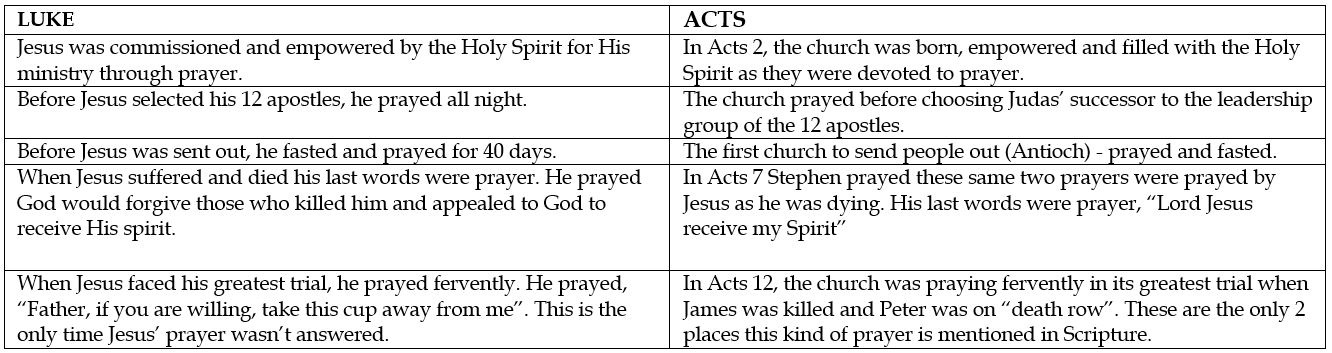
In studying the role of prayer in Luke and Acts together, an important and significant insight emerges. Luke shows us that the church’s prayer life mirrors and images Jesus’ own prayer life.

blob

What’s the takeaway from all these parallels? 1) Jesus builds his own life of prayer into His church. 2) Jesus builds his life of prayer into the church when they are at their most clueless, helpless, scared and weak (see question 2 below) 3) Jesus gave his life to give us his life of prayer. The “unanswered prayer” of Jesus is how all our prayer is made possible. In prayer, Jesus faced two choices – 1) God could take the cup from him or 2) he could take the cup from us. In prayer, He chose to take the cup of curse and separation to give us the cup of blessing and connection with God in prayer. When we pray, we receive the gift Jesus thought was worth dying for to give to us.

QUESTIONS FOR DISCUSSION

1.        What about the sermon most impacted you or left you with questions? What is most hard for you when it comes to prayer? What is most rewarding for you when it comes to prayer?

2.       Group exercise – Take a tour through the prayers of Acts (1-13).

a.        What do you observe about these prayers? Why did they pray? When did they pray? What can we learn from this?

3.        Jonathan Edwards once said, “Prayer is as natural an expression of faith, as breathing is of life; and to say a man lives a life of faith, and yet lives a prayerless life, is every whit as inconsistent and incredible, as to say, that a man lives without breathing.” If this is true, why is prayer so difficult? How might this explain why we can feel dry and lifeless in Christian practices (bible reading/study, Sunday worship, serving, etc)?

4.       Do you have any experience with fasting and prayer? If so, what have you learned from it? Why would a Christian want to fast? How might fasting help us see more clearly that prayer is a gift?

5.       It was said in the sermon, “It’s not so much that God answers the prayers of a church to be sent as it is that God sends a praying church.” What’s the difference? Why is this so important for us to learn in our attempts to do great things for God and for others?

6.       Take another look at the parallels between Jesus’ prayers and the prayers of the church in Acts. What strikes you? How is it encouraging to know Jesus is and will build his praying life into His church?

7.        Why is it so important to see how our prayers can be answered because of Jesus’ “unanswered prayer”? How might your perspective on prayer change if you believed that Jesus died to give you the gift of prayer?

8.       What is one thing you can do in 2019 to go deeper in prayer individually and as a group?